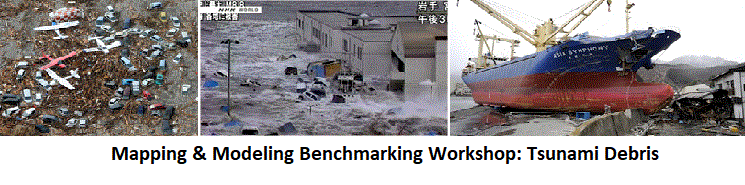
Benchmark Problem #3
This benchmark problem examines the transport of large objects by complex flow through a urban environment. The goal was to measure debris movement of a small number of large particles by complex 2D flow. The debris consisted of 3d-printed boxes and were placed in two different locations. A single, very-long-period wave crest was generated, and the debris was allowed to move through an urban layout.
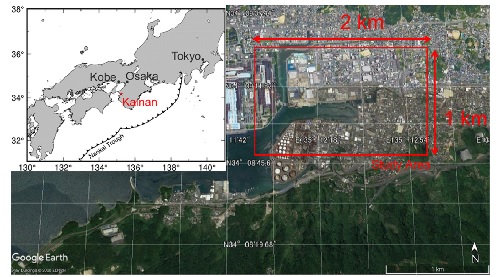
Complete details of the experiment can be found in the accompanying journal paper:
Chida, Y. and Mori, N., 2023. Numerical modeling of debris transport due to tsunami flow in a coastal urban area. Coastal Engineering, 179, p.104243.
[local pdf]
Modelers are asked to simulate two different cases in this paper for two different initial debris locations. Modelers may use their own hydrodynamic models, or they may use the Boussinesq-predicted wave results given below (for one-way coupled debris models). Modelers may also find the data comparison scripts in the modeled Boussinesq results useful.
Modelers are to provide comparisons with the mean distance traveled, lateral spreading, and longitudinal spreading for the cases. Modelers are encouraged to discuss various parameter changes used during the comparisons, such as grid size, time step, friction, breaking models, material properties, and any initiation and stopping thresholds for debris motion.
DOWNLOAD BENCHMARK DESCRIPTION : PDF DOC
DOWNLOAD DATASET: all_data.zip